From Milk to Cheese: A Human Invention
In Brief
Cheese is not produced by nature. It is a human invention created to transform fragile milk into a more stable, transportable and durable food. Through fermentation, coagulation, drainage, salting, pressing and heating, early pastoral societies learned to control milk and create the many cheese families we know today. This article explores the probable origins of cheese, the essential role of human knowledge and the fundamental actions of salt in preservation, texture, microbial control and maturation.
Keywords: cheese history, origins of cheese, ancient Persia, milk preservation, fermentation, coagulation, rennet, lactic cheese, cheese families, salt in cheesemaking, human craftsmanship, traditional cheesemaking
From Milk to Cheese: A Human Invention
Milk is one of nature’s most complete foods. It is also one of its most fragile.
Once separated from the animal, fresh milk rapidly becomes vulnerable to heat, contamination and microbial activity. For early pastoral societies, this created a fundamental challenge: how could such a nutritious food be preserved, transported and consumed over time?
Cheese was one of humanity’s answers.
Like wine, cheese is sometimes described as a natural product. Yet cheese does not exist in nature. A sheep, goat or cow produces milk—not cheese. Milk may sour or coagulate spontaneously, but uncontrolled transformation does not automatically create a stable, safe or pleasurable food.
Cheese begins when human beings observe these processes, understand them and learn how to guide them.
From Ancient Persia to the First Pastoral Societies
The exact birthplace of cheese remains uncertain because cheesemaking predates written history.
However, the vast region extending from ancient Persia and Mesopotamia through Anatolia and the Fertile Crescent played a central role in the domestication of sheep, goats and cattle. It is therefore likely that some of the earliest forms of fermented or coagulated milk appeared among the pastoral communities of these regions.
As with wine, cheese was probably not invented in a single place or at a precise moment. Different societies may have discovered independently that milk could be transformed through fermentation, acidification, coagulation, drainage and salting.
One often-repeated hypothesis suggests that milk transported in containers made from the stomachs of young animals coagulated through the action of natural enzymes. Whether or not this explains the first cheese, it illustrates an essential discovery: a fragile liquid could be separated into curds and whey and transformed into a denser, more durable food.
The original purpose of cheese was probably not gastronomic sophistication. It was preservation.
Transforming a Fragile Food
Fresh milk contains large quantities of water, along with lactose, fat, proteins, minerals and microorganisms. Without refrigeration, it deteriorates rapidly.
Cheesemaking reduces this fragility through a combination of biological and physical processes.
Lactic acid bacteria convert lactose into lactic acid. As the acidity increases, the structure of the milk changes and conditions become less favourable to many undesirable microorganisms.
Coagulation then organises the milk proteins, mainly casein, into a solid structure that traps fat and water. This may occur primarily through acidification, through enzymes such as rennet, or through a combination of both.
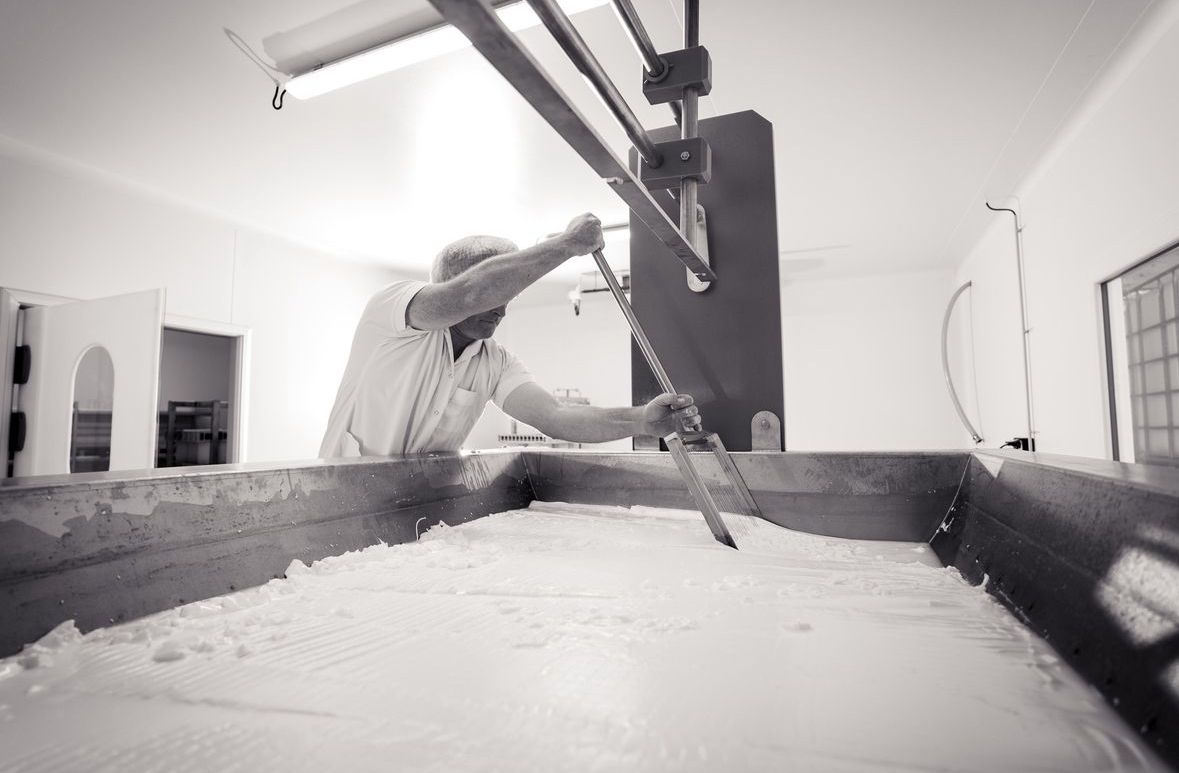
The curd is then cut, drained, moulded, salted and sometimes pressed or heated. Each of these operations removes moisture or modifies the environment in which microorganisms can develop.
Cheese is therefore not created through one single reaction. It results from a sequence of carefully controlled transformations.
Fermentation and coagulation made milk more stable and easier to transport, but they did not make it automatically risk-free. Poorly produced or badly stored cheese can still be dangerous. The real protection comes from the combined control of acidity, salt, moisture, temperature, hygiene and time.
The safety and stability of cheese are not gifts of nature. They are achievements of human knowledge.
Salt: Preservation, Structure and Flavour
Salt plays a fundamental role in cheesemaking. It is not simply added for taste: it helps control the development of microorganisms, slows excessive fermentation and reduces the amount of water available for unwanted microbial growth.
Salt also influences the structure of the curd by helping regulate moisture loss and firming the texture of the cheese. Applied directly, mixed into the curd or absorbed through brining, it affects how the cheese drains, how its rind develops and how it will mature over time. It can encourage certain desirable surface microorganisms while limiting others, making it an essential tool in both cheesemaking and affinage.
The quantity, timing and method of salting are therefore decisive. Too little salt may lead to instability and uncontrolled microbial activity; too much can inhibit ripening, dry the cheese excessively and mask the character of the milk. Salt is one of the simplest ingredients in cheese, but also one of the most powerful.
The Cheesemaker Creates Structure
Every major decision made during production influences the final identity of the cheese.
The cheesemaker decides:
- which milk to use;
- whether it will be raw or pasteurised;
- which cultures will guide fermentation;
- how quickly the milk should acidify;
- when and how much rennet should be added;
- how finely the curd should be cut;
- how much whey should be removed;
- whether the curd should be cooked;
- how the cheese should be salted;
- and how much moisture should remain.
A softer cheese generally retains more water. A hard cheese requires more drainage, pressure or heat. A lactic cheese develops through slow acidification, while many pressed cheeses depend more strongly on enzymatic coagulation and mechanical work.
The milk is the raw material. The cheese is the result of decisions.
The Main Families of Cheese
There is no single universal classification of cheese. It may be classified by milk type, moisture, texture, rind, coagulation method or maturation technique.
However, several broad families help explain how milk is transformed.
Fresh and Lactic-Set Cheeses
Lactic cheeses are produced mainly through acidification.
Lactic acid bacteria slowly transform the milk until it coagulates. Only a small amount of rennet may be used, or sometimes none at all.
The curd is delicate and is usually placed gently into moulds. These cheeses retain significant moisture and often have a fine, fragile texture.
Many traditional goat cheeses belong to this family. They may be eaten fresh or matured with ash, natural moulds or a wrinkled rind.
Rennet-Coagulated Cheeses
In rennet-coagulated cheeses, enzymes act directly on the milk proteins, creating a firmer and more elastic curd.
The curd can then be cut into grains of different sizes. Smaller grains release more whey and generally produce a drier cheese.
This technique is used for a wide range of soft, semi-hard and hard cheeses.
Soft Cheeses
Soft cheeses retain relatively high moisture and are usually matured for shorter periods than hard cheeses.
Their curd is not strongly pressed or heated. Depending on the treatment of the surface, they may develop a bloomy, washed or natural rind.
Their texture may evolve from firm and chalky to soft, creamy or even flowing.
Bloomy-Rind Cheeses
Bloomy-rind cheeses develop a white or ivory surface, often associated with moulds such as Penicillium camemberti.
The surface flora gradually transforms the paste beneath the rind. These cheeses ripen from the outside towards the centre.
Camembert and Brie are the best-known examples, but the category includes many regional and artisanal variations.
The rind is not a simple covering. It is an active biological layer.
Washed-Rind Cheeses
Washed-rind cheeses are regularly treated with brine or another liquid during maturation.
This creates conditions favourable to yeasts and bacteria adapted to humid, salty environments. The rind may become orange, pink, ochre or reddish, and the cheese often develops powerful aromas.
Époisses, Munster, Maroilles and Taleggio belong to this broad family.
Their character is created through repeated washing, rubbing, turning and observation.
Natural-Rind Cheeses
Natural-rind cheeses mature without the deliberate creation of a uniform white or washed surface.
Their rind develops through contact with the air, shelves, cellar and local microbial environment. It may be brushed, rubbed or simply monitored.
A natural rind is not an unmanaged rind. It requires constant attention.
Uncooked Pressed Cheeses
In uncooked pressed cheeses, the curd is cut, moulded and pressed without being heated to the higher temperatures used for cooked cheeses.
Pressing removes whey and creates a denser structure. Depending on the size and maturation period, the result may be supple, earthy, buttery or firm.
Many tommes, Cantal, Cheddar and Ossau-Iraty belong to this family.
Cooked Pressed Cheeses
For cooked pressed cheeses, the curd grains are heated before moulding and pressing.
This removes additional moisture and allows the cheese to mature for long periods.
Parmigiano Reggiano, Comté, Beaufort and Gruyère belong to this broad technological family.
Their complexity develops slowly, through time and deep enzymatic transformation.
Blue Cheeses
Blue cheeses are inoculated with moulds such as Penicillium roqueforti and pierced to allow oxygen to enter the paste.
The mould develops inside the cheese, creating blue-green veins and transforming proteins and fats.
Blue cheeses demonstrate particularly clearly that cheese is not simply preserved milk. It is a living material, reshaped by microorganisms and human intervention.
Cheese as a Cultural Creation
Cheese is often described today through simple categories: mild or strong, soft or hard, cow or goat.
These descriptions are useful, but incomplete.
A cheese contains the history of animal domestication, pastoralism, fermentation, agriculture, trade and local knowledge. It connects the animal to the landscape, the milk to the cheesemaker and the producer to the person who will eventually eat it.
Its identity lies not only in the milk, but also in the way that milk is handled.
This is why cheese should not be understood as a product that appears naturally from a territory. It is the result of human beings learning to work with living materials.
The first transformation happens in the dairy, when milk becomes curd.
But this is only the beginning.
Much of a cheese’s final identity will emerge later—through microorganisms, temperature, humidity, air, time and the work of the affineur.
About the author: Pierre Gouttenoire is an agricultural engineer, oenologist and cheese affineur. He co-founded the Jollie ecosystem in Tuscany and oversees its wine, food and regenerative agriculture projects.