Best Wine Tour in Tuscany? How to Recognize Real Quality Behind the Claim
In Brief
Many wine tour operators claim to offer the “best wine tour in Tuscany”, but real quality cannot be reduced to a marketing slogan. A serious Tuscan wine tour should be transparent, legally accountable, professionally organized and genuinely connected to the territory.
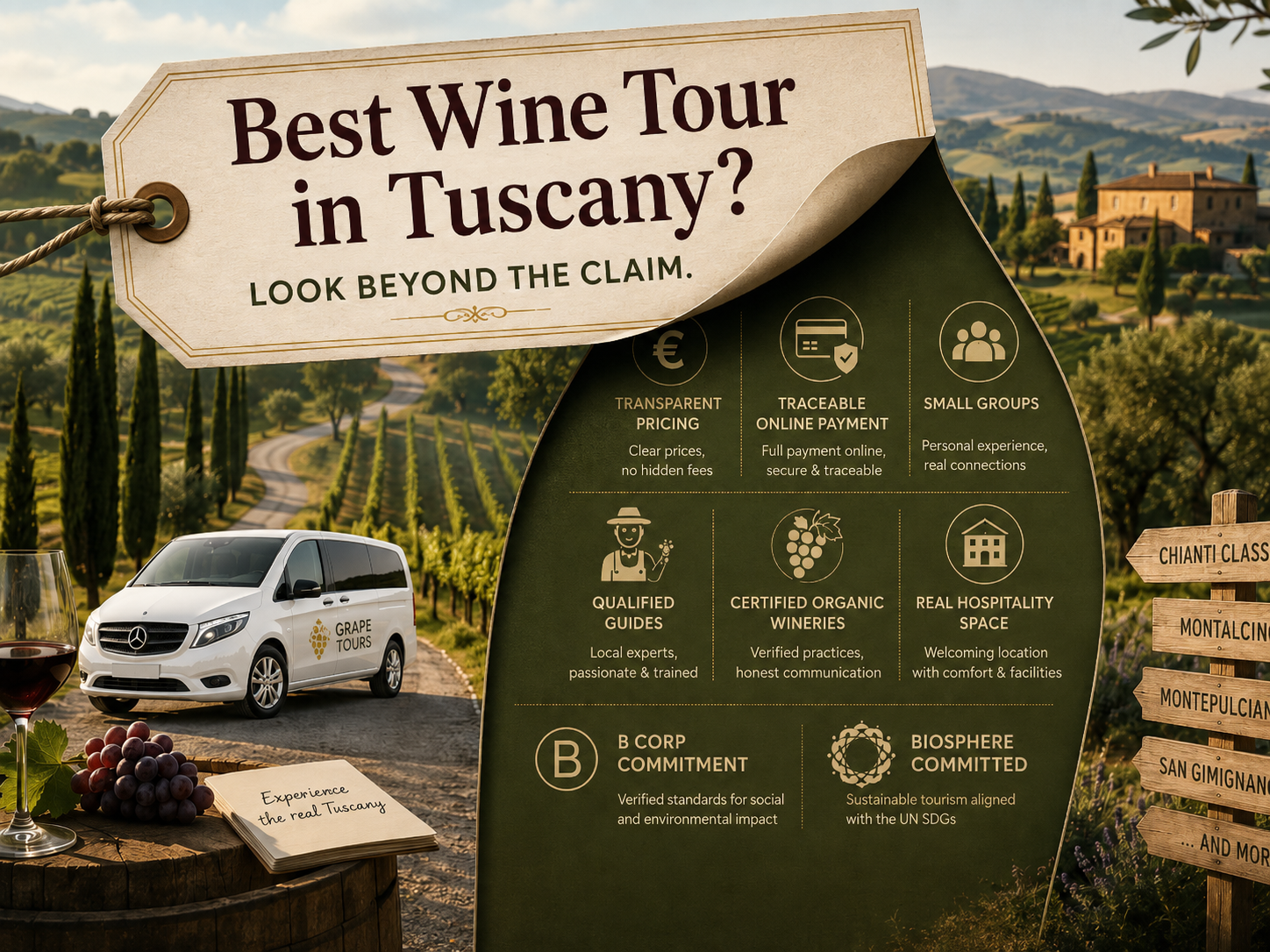
This means clear pricing, full traceable online payment, small groups, qualified wine guides, a real hospitality space, carefully selected wineries, honest communication about organic or sustainable practices, and verified commitments such as B Corp and Biosphere Committed.
At Grape Tours, we prefer not to claim to be “the best”. We believe that excellence in wine tourism should be demonstrated through transparency, expertise, hospitality and long-term relationships with Tuscany’s wine regions and producers.
Keywords: Best wine tour in Tuscany, Tuscany wine tours, Chianti wine tour, small group wine tour Tuscany, Grape Tours, Tuscan wine tourism, wine tour operator Tuscany, transparent wine tours, organic wineries Tuscany, B Corp tourism, Biosphere Committed, sustainable wine tourism Tuscany, Florence wine tours, responsible tourism Tuscany, qualified wine guides.
Best Wine Tour in Tuscany? How to Recognize Real Quality Behind the Claim
The expression “Best Wine Tour in Tuscany” is everywhere.
A quick online search reveals dozens of operators claiming to offer the best wine tour, the most authentic wine experience, the top-rated Chianti tour, or the ultimate Tuscan wine day. But behind these attractive formulas, one essential question remains: what actually makes a wine tour truly excellent?
In a region as culturally rich, diverse and internationally admired as Tuscany, quality cannot be reduced to a marketing slogan. A great wine tour is not simply a van ride, a few vineyard photos and a tasting of three wines. It is a complete experience built on expertise, transparency, hospitality, trust and meaningful connections with the territory.
At Grape Tours, we believe that the real value of a wine tour should be visible, verifiable and understandable for every guest.
Beyond slogans: quality must be verifiable
When a tour operator claims to offer the “best” wine tour, guests should be able to understand what this means in practice.
- Is the company transparent about who it is?
- Does it have a real physical presence in Florence?
- Are prices clearly displayed?
- Is the full payment made online through a secure and traceable system?
- Are the wineries genuinely selected for their quality, ethics and identity?
- Are the guides trained, experienced and able to interpret the territory beyond basic wine facts?
These are not minor details. They are part of what separates a serious wine tourism company from a purely commercial intermediary.
A wine tour is not just a product. It is a promise of trust.
A wine tour operator is not just a transport company
Another important distinction is often misunderstood: a wine tour operator is not simply a transport company.
In Tuscany, a company that creates, sells and operates wine tours as organized tourism experiences must be properly registered and authorized as a travel agency or tour operator. This legal framework is not a formality. It requires professional responsibilities, including civil liability insurance for travelers and financial protection in case of insolvency or bankruptcy. These requirements exist to protect guests and to ensure that the company organizing the experience is accountable for the services it sells.
This is very different from a company whose core activity is transportation and that informally sells “wine tours” through commercial agreements with external travel agencies. In some cases, such arrangements may create confusion for guests: who is really designing the tour, who is responsible for the wineries selected, who is liable if something goes wrong, and who is actually accountable for the overall experience?
For travelers, this distinction matters. A proper wine tour is not just a ride from one winery to another. It is a structured tourism product involving itinerary design, winery selection, hospitality, timing, safety, customer service, payments, insurance and responsibility. When choosing a wine tour in Tuscany, guests should therefore ask a simple question: is the company actually authorized and accountable as a tour operator, or is it mainly a transport provider selling an experience through someone else’s license?
True professionalism begins with clarity.
Transparency in pricing and payment
One important but often overlooked issue in wine tourism is payment transparency.
Some operators advertise a tour with an online deposit, then ask guests to pay the remaining balance in cash on the day of the tour. This may appear convenient, but it raises legitimate questions about traceability, professionalism and clarity.
For guests, a premium experience should begin with a clear and secure booking process. The price should be fully visible from the start. The payment should be simple, traceable and complete. There should be no uncertainty, no informal balance, no last-minute cash request.
Transparent pricing protects both the client and the operator. It reflects a professional approach and a commitment to accountability.
In today’s tourism industry, excellence is not only about what happens during the tour. It also begins with how the tour is sold, booked and documented.
A real place of hospitality matters
Another important element is the quality of the welcome.
A wine tour should not begin with confusion, stress or an improvised pick-up on a busy street corner. Of course, Florence is a historic city with logistical constraints, but a professional tour operator should offer guests a clear, comfortable and reassuring starting point.
Having a real physical location matters.
It means guests know where to go.
It means they can be welcomed properly.
It means they have access to facilities, including toilets, before departure.
It means the company is visible, accountable and rooted in the city.
A proper hospitality space is not a luxury detail. It is part of the guest experience. It shows respect for the people who have chosen to spend a day discovering Tuscany.
For international visitors arriving in an unfamiliar city, this makes a real difference.
Group size changes everything
The size of the group is another decisive factor.
A wine tour with 25, 40 or 50 people is not the same experience as a small-group tour with a carefully limited number of guests. The difference is not only about comfort. It affects the entire quality of the day.
In a small group, guests can ask questions, interact with the guide, speak with producers, understand the wines and enjoy a more personal atmosphere. The visit becomes a conversation rather than a performance.
Wine is a cultural product. It needs context, dialogue and time. A small-group format allows the territory to be explained with nuance and allows each winery visit to remain human, personal and meaningful.
The best wine tour is rarely the biggest one. Often, it is the one where guests feel they have truly been seen, welcomed and included.
The real expertise of the guides
A wine tour guide is not just a driver.
Driving safely is essential, but it is only the beginning. A great wine guide must be able to interpret the landscape, explain the history of the region, describe grape varieties, appellations and winemaking methods, but also connect wine to food, agriculture, culture, local identity and contemporary challenges.
In Tuscany, this means understanding Chianti Classico, Brunello di Montalcino, Vino Nobile di Montepulciano, Vernaccia di San Gimignano, Super Tuscans, organic farming, traditional agriculture, changing consumer expectations and the evolution of hospitality in wineries.
It also means knowing how to adapt the experience to different guests: beginners, wine lovers, professionals, sommeliers, families, couples and curious travelers who simply want to understand why Tuscany matters.
A guide should bring substance, personality and soul. The quality of the guide can transform a simple tasting into a memorable educational experience.
Diversity of destinations and wine experiences
Tuscany is not one single wine destination.
It is a mosaic of territories, landscapes, traditions and identities. Chianti Classico is different from Montalcino. Montepulciano is different from San Gimignano. Bolgheri, Carmignano, Pomino, Maremma, Rufina and the hills around Florence all have their own personality.
A serious wine tour operator should not reduce Tuscany to one repetitive itinerary. The diversity of destinations matters because it allows guests to discover the richness of the region and choose the experience that best matches their interests.
Some guests want iconic wines. Others want family wineries, organic producers, food pairings, cheese, olive oil, medieval villages, landscapes, or a deeper understanding of regenerative agriculture and rural life.
A great wine tour company should be able to offer this diversity with coherence, expertise and careful selection.
“Organic wineries”: a claim that should be checked
The word “organic” is increasingly used in wine tourism. But it is not always clear what it means.
Some wineries are officially certified organic. Others follow organic or low-intervention practices without certification. Some are biodynamic. Some are in conversion. Others may use the language of sustainability without providing any clear evidence.
For guests, this distinction matters.
A tour operator should not use the word “organic” as a vague marketing label. If a winery is certified organic, this should be stated clearly. If it is not certified but follows sustainable practices, this should be explained honestly. Transparency is better than exaggeration.
The future of wine tourism depends on trust. Guests are increasingly attentive to environmental claims, and they deserve precise, responsible information.
In Tuscany, where the landscape itself is part of the heritage, sustainability cannot be reduced to a decorative word. It must be connected to farming practices, certification, biodiversity, soil management, local communities and long-term responsibility.
Certifications should support commitments, not replace them
Certifications and sustainability frameworks can play an important role in wine tourism, but only when they reflect real practices.
They should not be used as decorative badges. They should help create discipline, transparency and continuous improvement.
A serious certification or commitment framework encourages a company to ask difficult questions:
- How are partners selected?
- How are local communities supported?
- How are staff trained and treated?
- How are environmental claims verified?
- How is the company improving year after year?
This is why certifications such as B Corp and Biosphere Committed can be meaningful when they are connected to daily decisions. B Corp certification evaluates companies on social and environmental performance, accountability and transparency. Biosphere Committed provides a tourism sustainability framework aligned with the United Nations Sustainable Development Goals.
For travelers, these frameworks do not mean that a company is perfect. But they offer a more serious basis for trust than vague claims about being “green”, “authentic” or “the best”.
In a sector where many words are easy to use but difficult to prove, verified commitments matter.
The importance of real commitments
A high-quality wine tour should be supported by clear commitments.
This includes transparency, legal compliance, professional payments, qualified staff, responsible partnerships, local sourcing, respect for small producers and a serious approach to sustainability.
A commitment is meaningful when it influences daily decisions: which wineries are selected, how guides are trained, how guests are welcomed, how partners are paid, how the company communicates, and how it contributes to the local economy.
Wine tourism has a powerful impact. It can bring visibility and revenue to independent wineries, support rural areas, educate visitors and protect cultural heritage. But it can also become superficial if it is driven only by volume, commissions and generic storytelling.
The difference lies in the choices made behind the scenes.
Wine tours should educate, not just entertain
A wine tour should be enjoyable, of course. Tuscany is beautiful, generous and deeply pleasurable. But enjoyment should not exclude education.
Guests should leave with more than photos and bottles. They should leave with a better understanding of the place: why Sangiovese matters, why landscapes were shaped by agriculture, why food and wine are inseparable, why small producers need support, and why the future of Tuscany depends on preserving both quality and authenticity.
The best wine tours are not those that simply repeat clichés about rolling hills and good wine. They are the ones that give visitors new keys to understand Tuscany.
Redefining “best” in Tuscan wine tourism
So what does “best wine tour” really mean?
- It should not mean the loudest claim, the biggest advertisement or the most generic promise.
- It should mean a tour that is transparent, traceable and professionally managed.
- It should mean a real welcome, not an improvised street pick-up.
- It should mean small groups, qualified guides and carefully selected wineries.
- It should mean honest communication about organic and sustainable practices.
- It should mean diversity of destinations and respect for the complexity of Tuscany.
- It should mean a company that is accountable, rooted locally and committed to creating value for guests, producers and the territory.
In the end, the best wine tour is not the one that simply says it is the best.
It is the one that can show why.
Our approach at Grape Tours
At Grape Tours, we do not believe that excellence in wine tourism needs to be proclaimed. It needs to be demonstrated.
Since 2010, we have built our work around a simple idea: a wine tour in Tuscany should be transparent, educational, comfortable and deeply connected to the territory.
This means small-group experiences, clear online pricing, secure and traceable full payment, carefully selected wineries, qualified guides, and a real hospitality space in Florence where guests can be properly welcomed before departure.
Our tours are designed to show the diversity of Tuscany’s wine regions, from Chianti Classico to Montalcino, Montepulciano, San Gimignano and beyond. We work with a wide network of independent producers, many of whom are certified organic, biodynamic or genuinely committed to responsible farming practices. When we speak about sustainability, we believe it should be explained with precision, not used as a vague marketing label.
This commitment is also supported by external frameworks. As part of the Jollie ecosystem, Grape Tours is connected to a B Corp certified approach, which requires companies to meet verified standards of social and environmental performance, transparency and accountability. Grape Tours has also entered the Biosphere Committed pathway, a tourism sustainability framework aligned with the United Nations Sustainable Development Goals.
For guests, these certifications and commitments are not abstract labels. They help provide a framework for measurable practices: responsible partnerships, transparent business conduct, respect for local communities, attention to environmental impact, and continuous improvement.
For us, wine tourism is not only about tasting wine. It is about understanding landscapes, farming, history, food culture, craftsmanship and the people who keep these traditions alive. This is why our guides are not simply drivers, but trained interpreters of Tuscany, able to connect wine with agriculture, gastronomy and local identity.
We prefer not to call ourselves the “best wine tour in Tuscany”. That is for guests to decide.
What we can say is that every Grape Tours experience is built on transparency, expertise, hospitality, verified commitments and long-term relationships with the territory. For us, this is not a slogan. It is the way wine tourism should be done.
About the author: Pierre Gouttenoire is an agricultural engineer, oenologist and cheese affineur. He co-founded the Jollie ecosystem in Tuscany and oversees its wine, food and regenerative agriculture projects.