How to Recognise a Truly High-Quality Tuscan Extra Virgin Olive Oil
In Brief
A high-quality Tuscan extra virgin olive oil should clearly identify its origin, harvest year, producer or mill, and any independent geographical certification. Extra virgin quality is established through both chemical analysis and professional sensory assessment: the oil must have no recognised defects and must present fruitiness. Bitterness and pungency are generally positive attributes, not signs of excessive acidity. Choose a recent harvest, protective dark packaging and a secure closure, and remember that olive oil progressively loses quality through exposure to light, heat and oxygen.
Keywords:Tuscan extra virgin olive oil, Chianti Classico DOP olive oil, high-quality olive oil, organic olive oil, Olio del Campo, Campo Sasso, Frantoio Pruneti, olive oil harvest year, olive oil label, olive oil tasting Tuscany, cold extraction, olive oil oxidation, sensory analysis, Grape Tours, Tasty Tuscany, Rebecca Gouttenoire, ONAOO olive oil taster.
Beyond “cold pressed”: understanding freshness, origin and the label through Olio del Campo
Olive oil is often presented as a simple, almost natural product: olives are harvested, pressed and transformed into oil. The reality is both more ancient and more technical.
For thousands of years, humans have extracted oil from olives through physical processes. Unlike wine, beer or cheese, olive oil is not created through fermentation. It already exists inside the cells of the fruit. Human intervention is needed to release it, separate it from the olive’s water and solid matter, and preserve its qualities for as long as possible.
This distinction is essential. High-quality extra virgin olive oil is not simply “olive juice”, nor is it the result of a romantic press operating unchanged since antiquity. It is a fragile agricultural product whose quality depends on the fruit, the timing of the harvest, the speed and precision of extraction, storage, packaging and, finally, how it is used after opening.
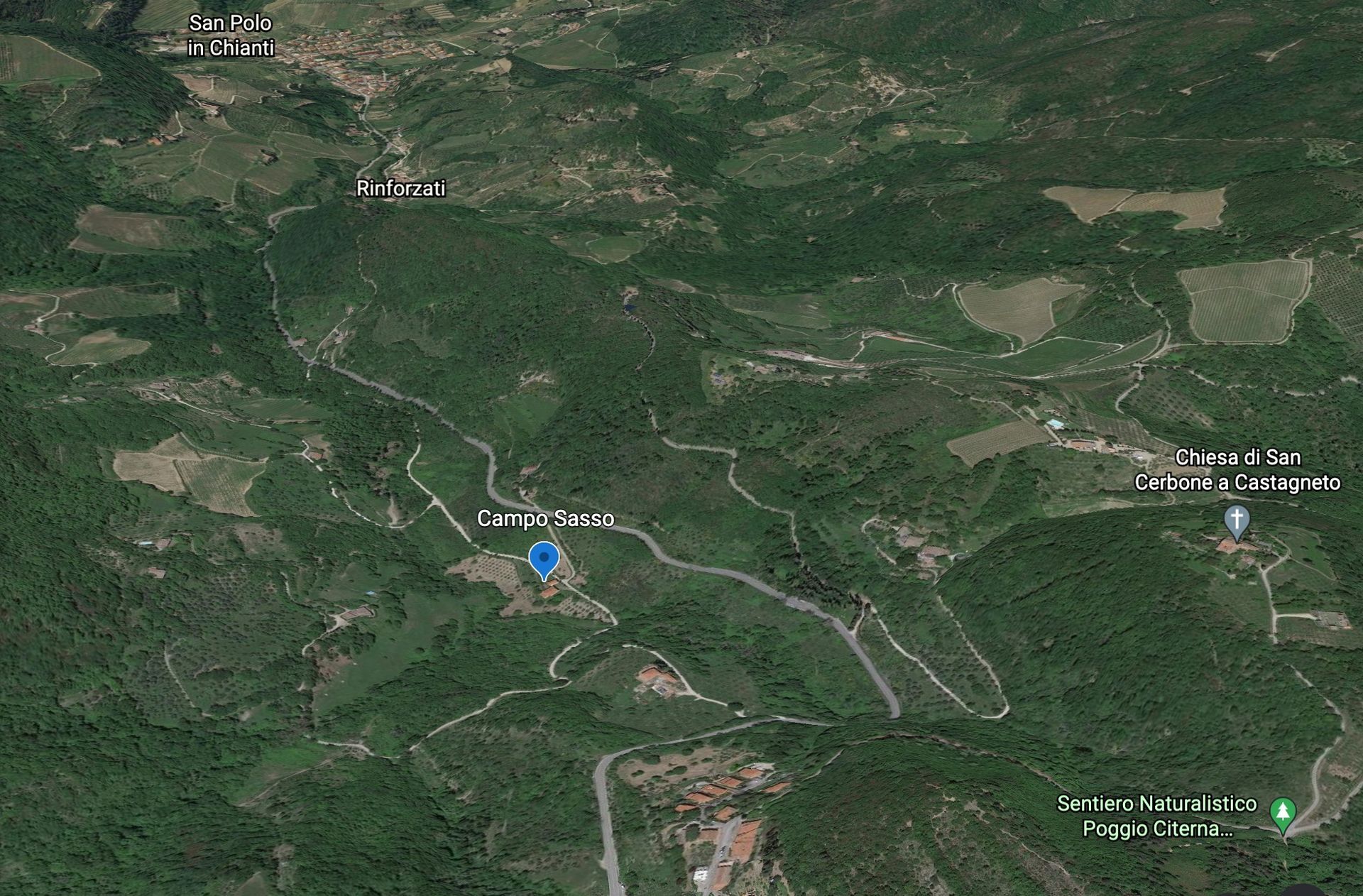
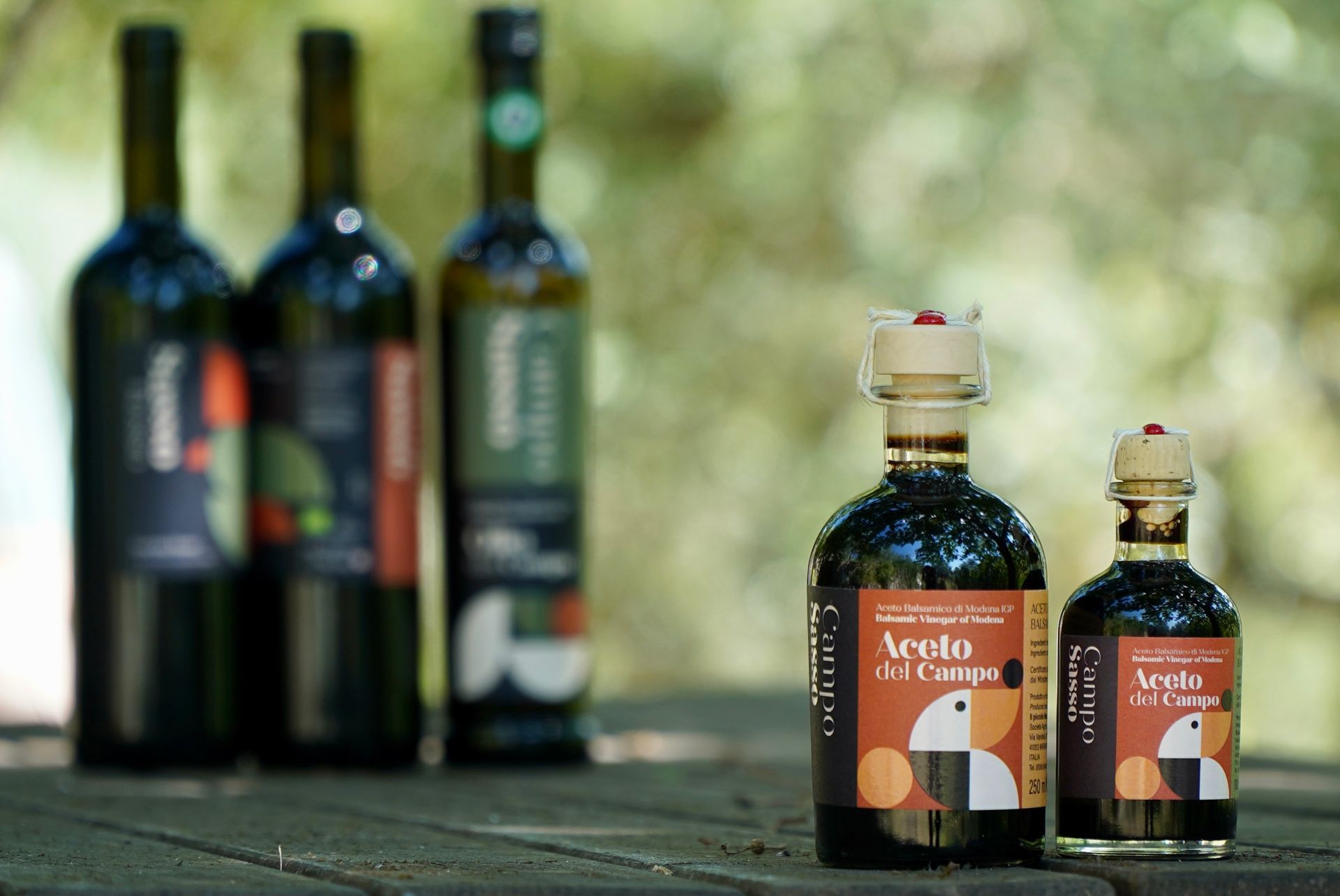
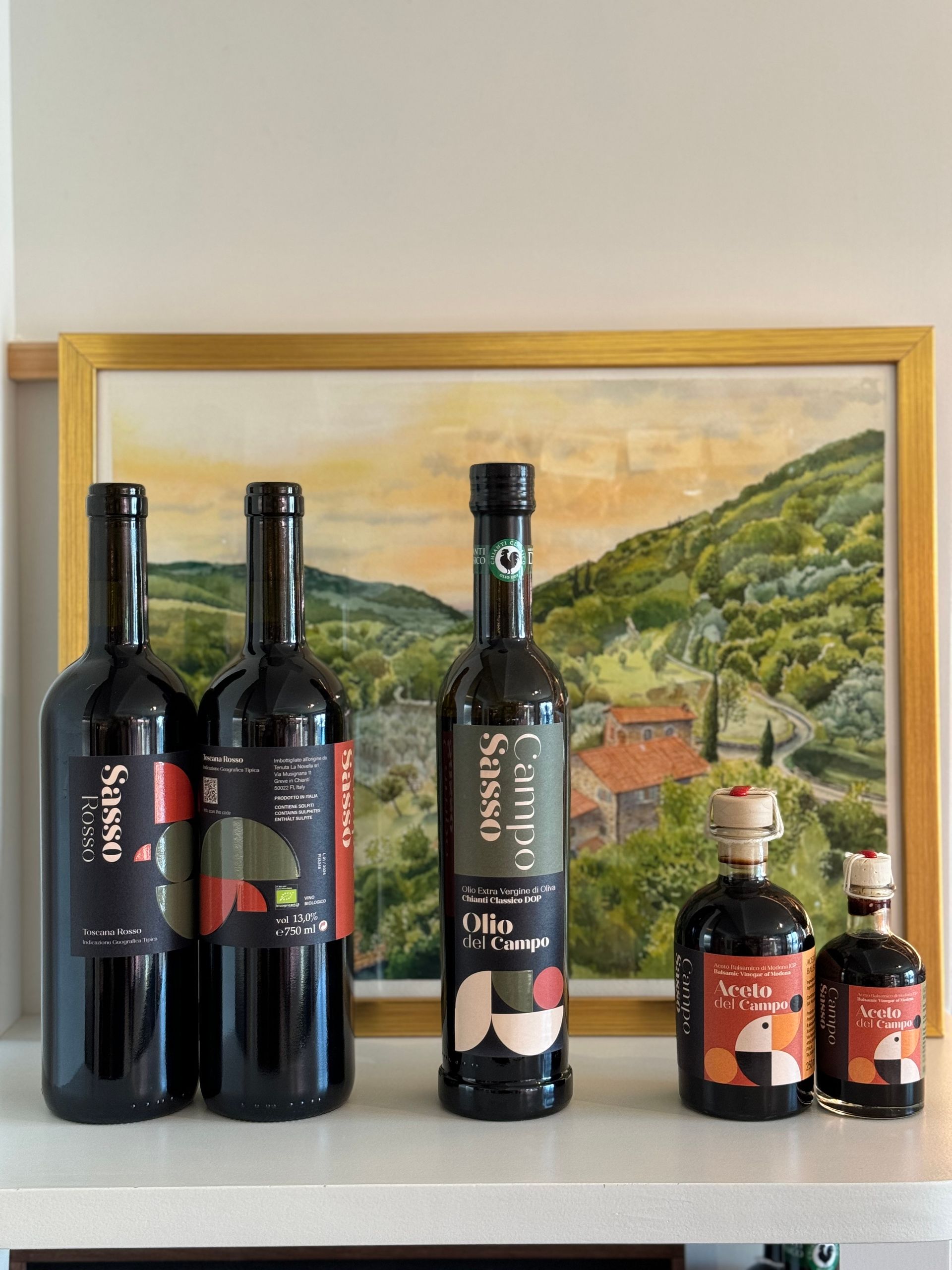
Olio del Campo, our organic Chianti Classico DOP extra virgin olive oil, embodies this complete chain of decisions. Produced in collaboration with Frantoio Pruneti in San Polo in Chianti, it connects the olive trees of Campo Sasso with the knowledge and modern technology of one of the region’s specialist olive mills.
Olive Oil Is Extracted, Not Fermented
The olive is a drupe—a fleshy fruit containing oil within its cells. To obtain that oil, the fruit must be physically broken and the liquid fraction separated from the water and solids.
Historically, olives were crushed with stone mills and the paste was pressed between fibre mats. The liquids were then left to settle so that the oil could be separated from the vegetation water.
The principle remains physical, but the equipment has changed considerably. In a modern quality mill, the process generally includes:
- Cleaning and washing the olives.
- Crushing them with a mechanical crusher.
- Malaxing the paste so that microscopic oil droplets can combine.
- Separating the oil, water and solid matter by centrifugation.
- Filtering and storing the oil under controlled conditions.
No fermentation is required. Olive oil contains virtually no fermentable sugars or free water capable of supporting normal microbial development. Plain olive oil therefore does not spoil in the same way as milk, meat or fruit juice.
Its principal enemy is not fermentation but oxidation.
This does not mean that olive oil can never present a food-safety issue: contamination, improper flavouring, illegal treatment or fraudulent substitution remain possible. However, for correctly produced and stored plain olive oil, ageing is primarily a matter of progressive sensory and nutritional deterioration rather than microbial spoilage.
For a deeper exploration of the Mediterranean history of olive oil and the evolution from traditional presses to modern extraction, read our guide to olive oil as a fruit transformed by human knowledge
“First Cold Pressed”: A Story That Often Belongs to the Past
Few expressions are repeated as confidently—and understood as poorly—as “first cold pressed”.
Under European legislation, “first cold pressing” may only be used for virgin or extra virgin olive oils obtained below 27 °C through a traditional hydraulic press. This description does not correspond to most modern quality mills.
“Cold extraction” is the appropriate term for oils separated below 27 °C through centrifugation or percolation. Both expressions are legally defined, but they describe different technologies. European rules on olive-oil marketing
Consequently, a retailer who describes every modern extra virgin olive oil as “first cold pressed” may be repeating a commercial cliché rather than providing meaningful technical information.
Nor does “cold extracted” automatically guarantee excellence. Temperature control matters, but so do:
- the health and maturity of the olives;
- the interval between harvesting and milling;
- hygiene throughout the mill;
- the duration and conditions of malaxation;
- protection from oxygen;
- filtration;
- storage temperature;
- and the age of the oil.
A technically correct expression is not a substitute for a transparent production chain.
What Does “Extra Virgin” Really Mean?
“Extra virgin” is a regulated category, not simply a producer’s promise.
Under European rules, an extra virgin olive oil must meet defined physicochemical criteria, including a free acidity of no more than 0.8%, together with limits for peroxide value, ultraviolet absorption and other analytical parameters. It must also pass an official sensory assessment: it must have no recognised sensory defects and must present perceptible fruitiness. European Commission overview of olive-oil categories
This is particularly important because chemistry alone does not fully describe an oil.
An oil can display acceptable acidity while lacking freshness, complexity or aromatic precision. Conversely, bitterness and pungency are not defects. In a fresh Tuscan oil, they are often positive expressions of healthy olives and phenolic compounds.
Professional assessment is carried out by a trained tasting panel following a standardised method. The tasters evaluate the oil independently, and the results are processed statistically. The panel looks for defects such as rancid, fusty, musty or winey-vinegary notes, as well as positive attributes such as fruitiness. International Olive Council sensory-assessment method
Extra virgin olive oil is therefore defined by two complementary forms of evidence:
- laboratory analysis establishes its physicochemical conformity;
- professional tasting confirms its sensory category.
Neither should replace the other.
Why Chianti Classico DOP Matters
A broad indication such as “Italian olive oil” provides relatively limited information. It may identify a country of origin, but it does not necessarily reveal a specific territory, group of cultivars, harvest or mill.
Chianti Classico DOP goes much further.
The protected designation connects the olives, extraction and packaging to a delimited production area between Florence and Siena. It also establishes stricter production, chemical, sensory and traceability requirements.
The principal traditional cultivars are:
- Frantoio;
- Moraiolo;
- Leccino;
- Correggiolo.
These varieties must account for at least 80% of the authorised olive groves, individually or together. Chianti Classico DOP oil is also subject to tighter criteria than the general extra virgin category, including maximum acidity of 0.5%, minimum total polyphenol levels and a defined sensory profile characterised by green fruitiness, bitterness and pungency. Every certified bottle carries an individual traceability mark. Chianti Classico DOP production specification
The DOP is therefore more than a geographical decoration. It provides a controlled relationship between origin, cultivars, processing and sensory identity.
Organic certification adds another dimension. It concerns how the olives are cultivated and how the production chain is managed. It does not, by itself, guarantee flavour or freshness, but it is an important and independently controlled part of the product’s agricultural identity.
How to Read an Olive Oil Label
Packaging cannot tell you everything about the oil, but it can reveal whether a producer is willing to provide meaningful information.
| What to look for | Why it matters |
|---|---|
| “Extra virgin olive oil” | Identifies the regulated category requiring chemical and sensory conformity |
| Precise geographical origin | More informative than a generic brand or Tuscan-looking image |
| DOP or IGP certification | Connects the oil to a controlled territory and production specification |
| Harvest year | Reveals the actual age of the oil |
| Named mill or place of extraction | Improves transparency and traceability |
| Dark green or opaque packaging | Helps protect the oil from light and photooxidation |
| Secure screw cap | Limits unnecessary contact with air and allows the bottle to be closed correctly |
| Organic certification | Provides controlled information about agricultural production |
| Lot number and certification seal | Allow the bottle to be traced |
None of these elements alone proves that an oil is excellent. A green bottle can contain an old or defective oil, and an attractive estate name does not necessarily reveal where the olives were grown or processed.
Quality becomes more credible when several elements converge: a recent harvest, precise origin, an identified mill, independent certification, suitable packaging and, ultimately, a clean and expressive taste.
Harvest Year Matters More Than the Best-Before Date
The best-before date is often misunderstood as an indication of when the olives were harvested. It is not.
It is a date of minimum durability established by the producer or bottler, commonly calculated from the time of bottling. An oil may therefore have been stored in bulk before being bottled. If the harvest year is absent, a distant best-before date does not tell the consumer how old the oil really is.
European rules allow a harvest year to appear only when 100% of the bottle comes from the stated harvest. For Chianti Classico DOP, the production year must appear on the label. This makes it much more useful than a best-before date alone.
The right question is not simply:
When does this bottle expire?
It is:
When were these olives harvested and transformed into oil?
Olive oil does not suddenly become dangerous when it passes its best-before date. Nor does it remain unchanged until that date. Its evolution is continuous, and quality may already have declined substantially long before the printed date if the oil was old when bottled or poorly stored.
Light and Oxygen: The Quiet Enemies of Olive Oil
Olive oil is particularly sensitive to light, oxygen and heat.
Light accelerates photooxidation, while oxygen promotes the progressive degradation of fatty acids, aromas, pigments and phenolic compounds. European regulations consequently require olive-oil labels to state that the product should be stored away from light and heat.
A dark green bottle is therefore not merely aesthetic. It slows the effect of light, although it cannot eliminate it completely. The bottle should still be kept in a closed cupboard, away from a window, oven or other heat source.
Once the bottle is opened, every use introduces fresh air into the headspace. Quality is then lost progressively, day after day. The oil may become less aromatic, less bitter and less pungent before eventually developing rancid notes.
For this reason, it is generally better to buy a bottle size suited to one’s real consumption rather than a large container that will remain open for many months. The cap should be closed immediately after every use, and open pouring spouts should be avoided for long-term storage.
Freshness is not permanent—even in the best oil.
Olio del Campo: A Transparent Expression of Chianti Classico
Olio del Campo is produced in very limited quantities from the principal olive varieties of Chianti Classico: Frantoio, Moraiolo, Leccino and Correggiolo.
The olives are grown within the Chianti Classico territory, including olives from the trees surrounding Campo Sasso, and are taken to Frantoio Pruneti in nearby San Polo in Chianti. Working with a specialised local mill allows the fruit to be processed rapidly and with precise control over each stage of extraction.
The oil is:
- certified Chianti Classico DOP;
- certified organic;
- identified by harvest year;
- milled locally in San Polo in Chianti;
- filtered for greater stability;
- bottled in dark green glass;
- and protected by a secure screw closure.
These visible elements do not replace tasting. They provide something equally important before the bottle is opened: a coherent and traceable account of where the oil comes from, how recently it was produced and who transformed it.
On tasting, a genuine Chianti Classico oil should not be neutral. Its green fruitiness, bitterness and peppery finish express the varieties, the early harvest and the phenolic structure of the oil. The slight burning sensation at the back of the throat is not excessive acidity—the acidity of olive oil cannot be tasted directly. It is a positive tactile response associated with certain phenolic compounds.
Olio del Campo is not intended to be a standardised fat with an indefinite shelf life. It is the expression of a harvest, a landscape and a precise moment in time.
Learn to Taste Extra Virgin Olive Oil in Tuscany with Grape Tours
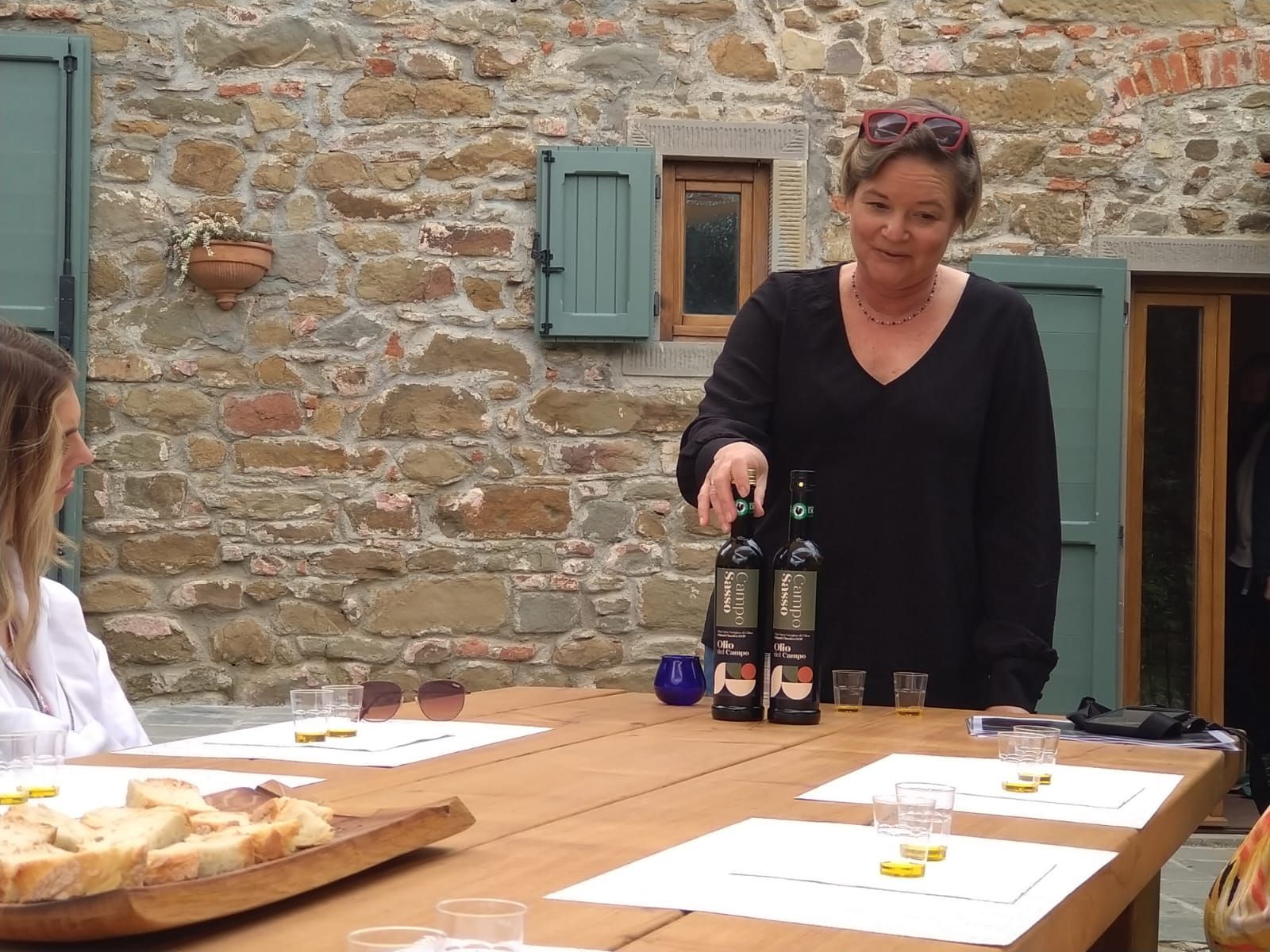
Reading a label is important, but tasting several oils side by side is the best way to understand what extra virgin olive oil quality really means. Fruitiness, bitterness and pungency cannot be reduced to a list of chemical values. They must be experienced, compared and explained.
This educational approach is central to several experiences created by Grape Tours. The Tasty Tuscany – Olive Oil & Wine Tour is a small-group experience limited to eight guests. It includes a visit to a specialist olive farm and mill, a guided tasting of Tuscan extra virgin olive oils, visits to family-run wineries and a seasonal farm-to-table lunch. The day connects olive oil and wine with the agricultural landscapes, cultivars, production methods and people behind them.
For travellers seeking a more personalised experience, the private Olive Oil & Wine Tour offers a deeper exploration of these two emblematic Tuscan products. Guests visit a renowned family-owned olive mill, compare monovarietal extra virgin olive oils and learn how different olive cultivars influence aroma, bitterness, pungency and food pairing. The experience continues at a selected winery with a cellar visit, wine tasting and farm-to-table lunch.
The knowledge behind these experiences has been shaped in particular by Rebecca Gouttenoire, co-founder of Grape Tours and an ONAOO-qualified olive oil taster. Her professional training in the sensory evaluation of extra virgin olive oil complements more than two decades of experience in Tuscan wine and food tourism. This expertise helps guests move beyond familiar marketing expressions and learn how to recognise fruitiness, identify genuine sensory defects and understand why bitterness and pungency are generally positive attributes rather than signs of excessive acidity.
Through these tours, olive oil is no longer treated as a simple accompaniment placed on the table. It becomes an agricultural product to be tasted with the same attention, vocabulary and respect as wine.
Quality Is Also the Courage to Give Clear Information
A trustworthy olive-oil label should help the consumer understand the product rather than distract them with vague images of Tuscany, tradition and stone presses.
Look for the harvest, not only the best-before date. Look for a precise origin, not merely an Italian flag. Look for an identified mill and an independently controlled designation. Protect the bottle from light, heat and air—and use the oil while its aromas are still alive.
Extra virgin olive oil has been made through human knowledge for millennia. Modern technology has not made that heritage less authentic. When it is used intelligently, it allows us to protect the fruit more precisely and to preserve, for a limited time, the taste of a Tuscan olive harvest.
That is the purpose of Olio del Campo—and of the olive oil experiences offered through Campo Sasso and Grape Tours: to make the identity of Chianti Classico transparent, traceable and alive, from the olive grove and the mill to the tasting table.
About the author: Pierre Gouttenoire is an agricultural engineer, oenologist and cheese affineur. He co-founded the Jollie ecosystem in Tuscany and oversees its wine, food and regenerative agriculture projects.